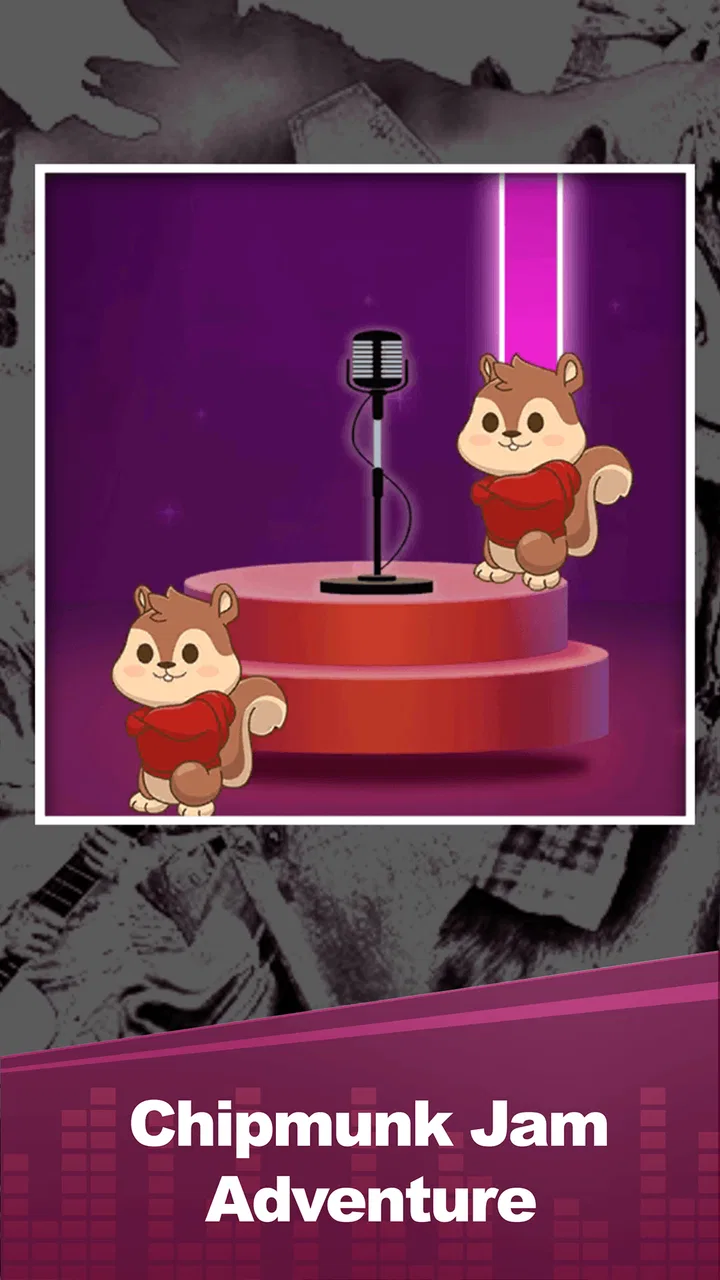
Chipmunks Music Journey
- 4.0
- Rating
- 1.00M
- Installs
- Free
- Price

 Analysis by App-foxy
I went into Chipmunks Music Journey expecting a small, cheerful music game, and that is exactly where it works best. It is a free Android game from GMG Global, built around cute chipmunk voices and familiar-feeling song play rather than a deep campaign or a serious rhythm challenge. The basic appeal is immediate: you tap, listen, react to the musical feedback, and decide whether to try another short round.
That simplicity makes it easy to understand, especially for younger players or anyone who wants something light during a spare moment. It is also the source of its main limitation. This is not the kind of music game I would choose when I want demanding timing mechanics, a large artist catalogue, or a long-term competitive system. I see it more as a friendly pick-up-and-play experience, with the chipmunks providing most of the personality.
How the music loop feels from the first tap to the next round
I look at the opening loop as a quick test of whether the game’s sound and tapping feel inviting together, rather than as a challenge to rush through. Paying attention to that first response can help you decide whether to keep playing or take a break before the cute voices start to feel repetitive.
You May Also Like

 Blood Strike: 2.5 Anniversary
Blood Strike’s Loadouts Turn Every Drop Into a Tactical Gamble
A close look at Blood Strike’s custom loadouts: how fast access to signature weapons reshapes its battle royale rhythm, rewards preparation, and narrows the gap between fights.

 Pandora - Music & Podcasts
Pandora’s Music Is Easy to Start, but Harder to Recover
Pandora’s strength is its low-effort path from a seed to a station. Its weak spot is how much confidence it asks you to place in connection, setup, and quiet recovery.

 8 Ball Pool
 Is Built on Rivalries, Rematches, and Routine
A close look at the rivalries, rematches, shared routines, and unanswered safety questions that turn a quick pool match into a persistent mobile community.

 Samsung Music
’s Quiet Strength Is Playing What You Already Own
Its reach comes less from spectacle than from dependable access to a personal library. That simplicity is both the app’s strongest retention engine and its ceiling.

 AccuWeather: Weather Radar
AccuWeather Review: A Quick, Clear Forecast for Everyday Decisions
For everyday plans, the best forecast is the one you can understand quickly. AccuWeather makes rain timing, radar, and local conditions easy to act on, with a few trade-offs.

 Hill Climb Racing
Why Hill Climb Racing Still Turns Crashes Into One More Run
A tiny car, a bumpy hill and one more upgrade: Hill Climb Racing keeps resurfacing because its simple chaos makes every near-miss feel personal.
More From Our News Desk



The first action is simple, and that is part of the appeal
The opening experience is deliberately approachable. You do not need to study a complicated control scheme before enjoying it. The game presents its music-focused idea quickly, and the natural first move is to begin interacting with the song content through taps. That low barrier matters because the audience for a cute voice-based game is not necessarily looking for a tutorial-heavy rhythm title.
In my experience, the best way to approach it is with headphones or a modest volume level rather than treating it like a silent puzzle. The voices and musical responses are central to the charm, so playing with sound turned off removes much of what makes this particular game different from a generic tapping app. It is also worth starting with short sessions. The game is easier to appreciate when I treat it as a quick musical break instead of expecting a full evening of content.
The controls feel suited to casual use. I can imagine playing it while waiting for an appointment, taking a short break from work, or handing the phone to a child for a brief, supervised turn. The visual and vocal tone makes it less intimidating than many rhythm games, which often assume that the player wants speed, precision, and increasingly difficult charts from the beginning.
That accessibility does not mean every player will find the first interaction equally satisfying. If you prefer instruments, beat maps, or exact note lanes, the cute presentation may feel too soft. The game’s identity is closer to playful musical interaction than to a serious practice tool. I would not install it expecting to improve timing in the way a dedicated rhythm trainer might help.
Feedback gives each tap a reason to continue
The important part of the loop is the response after an action. A tap is not just a silent input; it is meant to connect with the song and the chipmunk presentation. The voices make the feedback feel more characterful than a plain beep or a generic score effect. That gives the game a friendly rhythm: act, hear a response, notice the result, and try to keep the musical flow going.
This audio feedback is the strongest reason to play with sound available. In a conventional puzzle, visual confirmation may be enough. Here, the sound is part of the reward. The chipmunk-style delivery turns a small successful interaction into something playful, while an imperfect moment encourages another attempt without making the experience feel harsh.
I also found that the feedback works best when I stop trying to rush. A common mistake with casual music games is tapping as quickly as possible and then blaming the game when the sequence feels messy. A steadier approach makes it easier to notice how the song and responses fit together. For younger players, that can become a gentle introduction to following a beat, even though I would not describe the game as a structured music lesson.
There is a trade-off here. The same vocal style that makes the game memorable may become repetitive if I play for too long in one sitting. Cute sounds have a strong first impression, but they need variety to remain fresh over extended sessions. I recommend alternating it with another activity rather than treating it as an endless soundtrack.
The reward is immediate enjoyment rather than a complex progression system
What keeps me engaged is the small payoff after a successful interaction: the song continues, the voices reinforce the action, and the whole scene feels lively for a moment. This is a modest reward, but it suits the game’s scale. I do not need to prepare for a long challenge to get something back from it. A few taps can be enough to create a satisfying miniature performance.
That makes the game a good fit for children who enjoy character voices and music more than elaborate stories. It can also work for adults who want a deliberately uncomplicated distraction. I would especially recommend it to someone who likes cute, sound-driven apps but does not want the pressure found in competitive rhythm games.
The free entry point helps with that decision. I can try the core experience without paying upfront, while optional in-app purchases range from $0.99 to $3.49 per item. Because of that, I would approach purchases carefully and let the free experience establish whether the loop has enough variety for me first. A small purchase may feel reasonable to a committed fan, but it is not something I would assume every casual player needs.
The reward structure is also why expectations matter. Players looking for a large collection of unlockables, deep character development, or a demanding mastery curve may find the payoff too light. The game is rewarding in short bursts, not because it builds an elaborate long-term achievement journey. That distinction is important before downloading it.
Resetting the session keeps the game easy to pick up
After a round or musical interaction ends, the natural appeal is to begin again without much preparation. That reset is central to the experience. There is no need for me to remember a complicated build, plan a route, or recover from a lengthy failure. I can put the phone down and return later with very little mental overhead.
This is useful in everyday situations. If I have only a few minutes before a bus arrives, I can play without worrying that I am abandoning a long mission. If a child loses interest, the session can stop naturally instead of leaving an unfinished story or a difficult checkpoint. The same reset also makes it suitable for shared use, where different people may want to try the musical interactions one after another.
The downside is that a frictionless reset can reduce urgency. When each attempt feels self-contained, I may enjoy the moment without feeling a strong reason to improve over many sessions. That is not a flaw for a casual game, but it does limit its ability to become a mainstay on my phone. I see the reset as a convenience first and a progression feature second.
My practical tip is to use the reset as a boundary. Play a round or two, then decide whether the feedback still feels fresh. If the voices and song interactions are making you smile, continue. If I am tapping automatically without listening, that is usually a sign that the short-session design has done its job and it is time to stop.
Where it fits beside other music games
Compared with a traditional rhythm game, this title feels friendlier and less demanding. A serious rhythm alternative usually focuses on precise lanes, fast reactions, score chasing, and a clear difficulty climb. That is the better choice for players who want to train timing, compete with friends, or measure improvement through increasingly difficult songs.
Compared with a music streaming app, this game offers interaction instead of passive listening. I am not choosing it to build a playlist or discover artists. I am choosing it because the chipmunk voices turn music into a small activity. If I want background audio while working, a streaming service is more practical. If I want a playful few minutes with a child, this game has a more direct sense of participation.
It also differs from educational music apps. Those products often organize lessons, exercises, or clearly explained concepts. Here, the learning value is incidental. A player may become more attentive to rhythm and sound, but I would not rely on it as a substitute for an instrument app or a structured musical course.
That comparison clarifies who should skip it. I would look elsewhere if I wanted a broad music library, advanced difficulty settings, competitive leaderboards, or a serious sense of progression. I would also skip it if repetitive character vocals quickly irritate me. The game’s personality is not a small decoration; it is the central feature, so it needs to match my taste.
Practical details before installing
The game is rated for Everyone, which matches its cheerful, accessible presentation. That makes it easier to consider for family use, although I would still stay nearby with a younger child, particularly because any game with optional purchases deserves an adult’s attention on a shared device.
It runs on Android devices using version 6.0 or newer. That minimum makes it available to people who are not using a recent phone, though performance and sound quality will naturally depend on the individual device. I would check that the phone’s audio is working properly before judging the game, because muted or distorted sound removes the main feedback that separates it from a basic tap toy.
The game has passed the casual-download stage in a meaningful way, with over a million installs, and its average rating is 4.1 from around 700 ratings. Those figures suggest that the concept has found an audience, but they do not guarantee that every player will enjoy the same vocal style. I would treat the rating as a useful signal of general appeal rather than proof that it offers the depth of a larger rhythm franchise.
The current version is 1.0.15, and the developer is GMG Global. I would keep the app updated through the normal store process, especially if I plan to use it regularly, since updates can matter for compatibility and smooth playback. The game was released on October 3, 2022, so it is established rather than a brand-new experiment, but I still judge it mainly by the quality of its short-session loop.
Three ways to get more from the short format
First, I would use the game as a sound-focused break instead of playing it silently. The most distinctive feedback comes through the voices, and listening closely makes the timing feel more intentional. This is a small change, but it prevents the experience from blending into every other tap-based game.
Second, I would make it a turn-taking activity. With a child or a friend, one person can try a musical interaction while the other listens for the chipmunk response. That changes the game from a solitary time filler into a tiny performance, without requiring a second device or a competitive scoring system.
Third, I would use short repeat sessions to test variety rather than forcing a long marathon. Start, listen, play, reset, and then decide whether the next attempt still feels different enough. This approach helps me notice the point at which the vocal charm becomes repetitive, and it prevents the free game from feeling disappointing simply because I asked it to provide hours of depth.
A fourth useful trade-off is to separate audience from ambition. For a young player who wants recognizable musical fun, the simple loop may be exactly right. For an experienced rhythm-game fan, the same simplicity may feel unfinished. Neither reaction is wrong; the game succeeds when judged as a cute, accessible music toy, not when measured against a demanding performance title.
My verdict on the action-feedback-reward-reset loop
My overall impression is positive, with clear limits. The action is easy to understand, the feedback has personality, the reward arrives quickly, and the reset makes another session effortless. That sequence gives the game a pleasant reason to keep playing for a few minutes: I tap, hear the chipmunks respond, enjoy the musical result, and begin again when I want one more little performance.
The best reason to choose it is its immediate, character-led musical feedback. It is welcoming, free to start, suitable for Everyone, and light enough for casual play. I can recommend it to families, younger players, and adults who enjoy playful voices more than competitive mechanics.
I would not recommend it as a replacement for a full rhythm game, a music-learning tool, or a streaming service. Its charm depends heavily on whether I enjoy the chipmunk presentation, and its short-loop design may not hold my attention for long sessions. Optional purchases also mean I would try the free experience first and spend only if the available content genuinely earns that decision.
For the right player, Chipmunks Music Journey is a cheerful little music game that understands the value of an uncomplicated loop. It does not need to become a huge challenge to be enjoyable. When I want a quick, sound-led distraction with cute voices and almost no learning curve, it earns a place on my shortlist. When I want depth, precision, or lasting progression, I reach for a different kind of music game.
FAQs for Chipmunks Music Journey
01What is Chipmunks Music Journey and how does it work?
Chipmunks Music Journey is an interactive rhythm game available for both Android and iOS. Players guide their favorite chipmunk characters through various musical levels, tapping in time with the beat. The game features a range of popular songs, each level requiring players to achieve specific rhythmic goals to progress and unlock new content.
02Are there in-app purchases in Chipmunks Music Journey?
Yes, Chipmunks Music Journey offers in-app purchases. Players can buy additional songs, outfits for characters, and power-ups to enhance their gameplay experience. While the game is free to download, these purchases allow for a more customizable and enriched experience, although they are not necessary to enjoy the core gameplay.
03Is an internet connection required to play Chipmunks Music Journey?
An internet connection is required to initially download the game and access certain online features, such as leaderboards and updates. However, once downloaded, players can enjoy most of the gameplay offline, making it a great option for on-the-go entertainment without needing constant connectivity.
04What age group is Chipmunks Music Journey suitable for?
Chipmunks Music Journey is designed for all ages, offering a family-friendly experience. The game’s simple controls and colorful graphics make it accessible to younger players, while its challenging levels and diverse music selection appeal to older audiences. Parents can feel comfortable with the game's content as it is free from inappropriate material.
05Can I play Chipmunks Music Journey with friends?
Currently, Chipmunks Music Journey is a single-player experience. However, players can compete against friends by sharing scores on social media or through in-game leaderboards. This competitive element adds a social aspect to the game, encouraging players to improve their skills and achieve higher scores.
Pros
- Engaging music-based gameplay.
- User-friendly interface.
- Variety of levels and challenges.
- Visually appealing graphics.
- Regular updates with new content.
Cons
- In-app purchases can be pricey.
- Requires constant internet connection.
- Occasional ads disrupt gameplay.
- Limited offline features.
- Some levels can be repetitive.

Chipmunks Music Journey
Gallery